
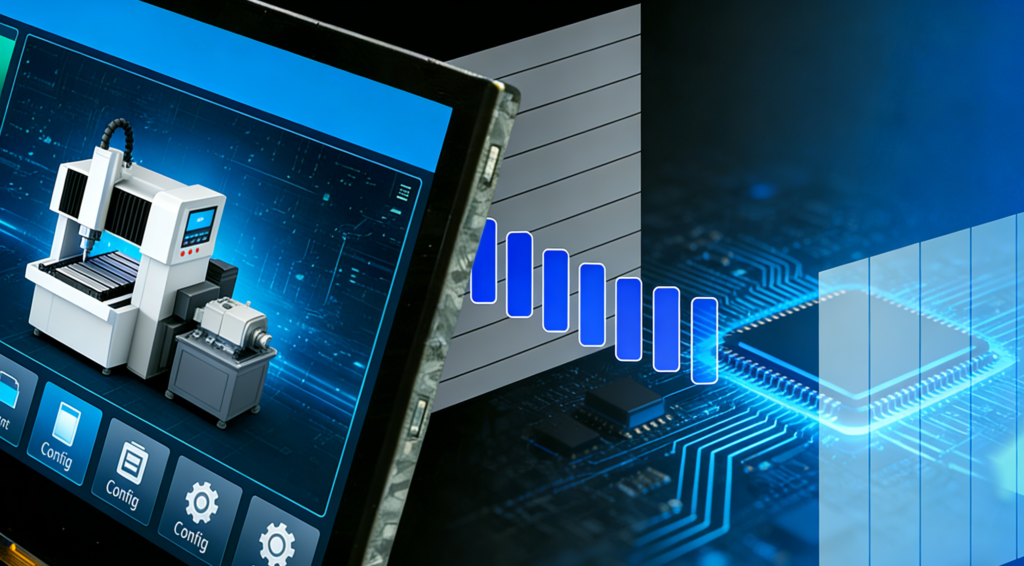
Display technology has evolved continuously for more than a century and remains one of the core driving forces in the global electronics market. IPS (In-Plane Switching) display technology was first developed in the 1990s to solve common problems with color distortion and narrow viewing angles on traditional LCD panels.
Today, IPS TFT LCD panels are widely recognized for delivering outstanding color performance and wide viewing angles compared with other mainstream display types, including VA (Vertical Alignment) and TN (Twisted Nematic). For small and medium-size display applications, 0.96 inch to 10.4 inch IPS TFT LCD modules have become a top choice for industrial, medical, smart device, and consumer electronic products.
What Is IPS Display Technology?
IPS (In-Plane Switching) is an advanced LCD screen technology widely used in TFT LCD modules. Unlike traditional panel structures, IPS technology changes the rotation direction of liquid crystals to provide sharper images, more accurate colors, and a better overall viewing experience.
IPS displays belong to the TFT LCD panel family, together with TN and VA panels. This technology is widely applied in various devices, such as:
• Industrial control displays
• Smart home appliances
• Handheld terminals
• Medical equipment
• Wearable devices
• Automotive displays
• Consumer electronics
Our focus is on high-performance IPS TFT LCD modules in sizes ranging from 0.96 inch to 10.4 inch, supporting customized solutions for different industries.
How Does IPS Display Work?
The working principle of an IPS display is based on in-plane liquid crystal rotation. When voltage is applied, the liquid crystals rotate parallel to the glass surface instead of vertically. This unique structure allows light to pass through more smoothly and reduces light interference and leakage.
By improving light transmission and control, IPS displays produce clearer, more stable, and more consistent images than standard TN or VA panels, especially when viewed from different angles.
Key Benefits of IPS TFT LCD Displays
IPS displays offer multiple advantages that make them ideal for 0.96–10.4 inch small and medium-size TFT LCD modules:
Wide & Stable Viewing Angles
One of the biggest advantages of IPS technology is its excellent viewing angle performance. Images and colors remain accurate from nearly any horizontal or vertical angle, with almost no color shift or fading. This is a huge improvement over TN panels, which often lose image quality at wider angles.
Accurate & Vivid Color Reproduction
IPS displays deliver natural, true-to-life colors and can produce more than 16 million colors. This high color accuracy makes IPS TFT LCD modules perfect for applications that demand clear and realistic visuals.
Good Visibility in Different Lighting Environments
With a high-quality LED backlight, IPS panels perform well in both indoor and bright outdoor environments. They maintain better visibility in direct sunlight compared with many TN and VA displays.
Stable & Reliable Image Performance
IPS panels offer balanced contrast, fast response, and consistent performance, making them suitable for long-term use in industrial and daily applications.
IPS vs TN vs VA: What Are the Differences?
Understanding the differences between IPS, TN, and VA helps you choose the right display for your project.
• TN Panel: Low cost, fast response, but narrow viewing angles and average color performance.
• VA Panel: High contrast and deep blacks, but slower response and limited viewing angles.
• IPS Panel: Best color accuracy, widest viewing angles, and balanced overall performance.
For most applications using 0.96 inch to 10.4 inch TFT LCD modules, IPS is the most recommended choice when visual quality is important.
Disadvantages of IPS Displays
While IPS displays provide excellent performance, there are some limitations to consider:
Higher Power Consumption
IPS TFT LCD panels generally consume about 15% more power than standard TN panels because they require a constant LED backlight.
Higher Production Cost
Due to more advanced materials and manufacturing processes, IPS displays are usually more expensive than TN panels.
Lower Contrast Than OLED
Unlike OLED panels, IPS displays cannot fully turn off pixels to achieve pure black, so their contrast ratio is lower than OLED.
Why Choose IPS for 0.96–10.4 Inch Screens?
For small and medium-size displays from 0.96 inch to 10.4 inch, IPS TFT LCD modules offer the best combination of:
• Wide viewing angles
• Stable and accurate colors
• Good performance in different environments
• High reliability for industrial and consumer use
If you need clear, consistent, and high-quality visuals for your electronic products, IPS display technology is an excellent long-term solution.
Conclusion
IPS display technology continues to be one of the most popular and reliable choices in the TFT LCD industry. With continuous improvements, IPS panels are now widely used in a variety of applications, especially for 0.96 inch to 10.4 inch display modules.
Whether you are developing industrial equipment, smart devices, medical tools, or consumer electronics, IPS TFT LCD panels provide outstanding viewing angles, color accuracy, and stability.
If you do not require ultra-high refresh rates and accept slightly higher power consumption for better visual performance, an IPS display will greatly improve the quality and user experience of your product.